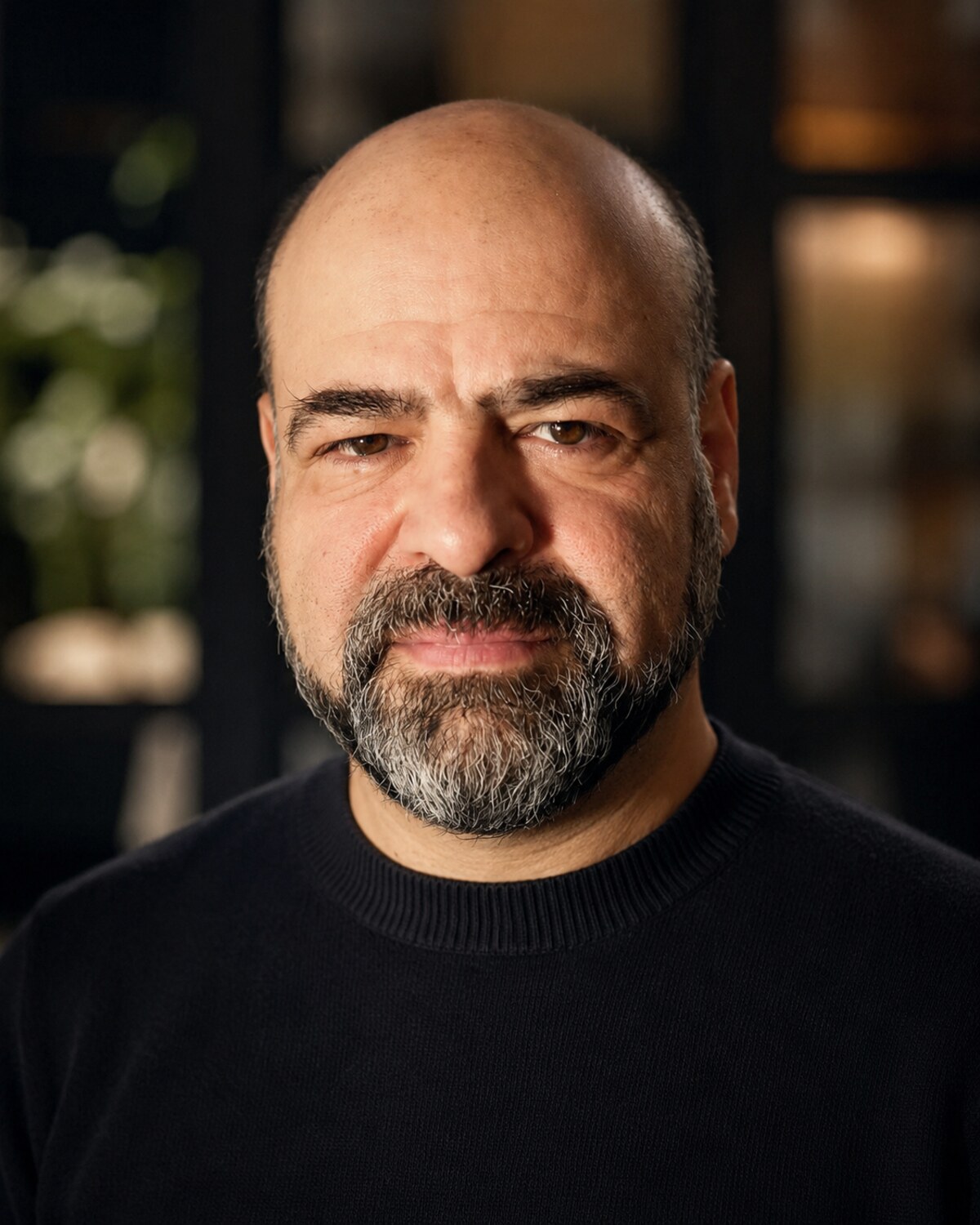
Gil Carrasquero was born in Caracas, Venezuela, on July 24th, the day his country honors the birth of its founding hero — a coincidence that, in a family like his, felt less like chance than like instruction. His was a lineage of public distinction: a family of distinguished lawyers, an attorney general, a minister of state, an ambassador, a grandmother who founded the nation's nursing profession. In such a family, and in a country where to hold power was the highest form of significance, affection arrived with conditions and it came through admiration. One had to shine in order to be loved. From this, the boy drew the lesson that would organize the first four decades of his life — that a man is worth what he achieves, and that he would have to achieve more than those who came before him.Gil Carrasquero nació en Caracas, Venezuela, el 24 de julio, el día en que su país honra el nacimiento de su héroe fundador —una coincidencia que, en una familia como la suya, se sintió menos como azar que como instrucción. La suya era una estirpe de distinción pública: una familia de abogados distinguidos, un fiscal general, un ministro de Estado, un embajador, una abuela que fundó la profesión de enfermería del país. En una familia así, y en un país donde ostentar el poder era la forma más alta de significación, el afecto llegaba con condiciones y llegaba a través de la admiración. Había que brillar para ser amado. De ahí extrajo el niño la lección que organizaría las primeras cuatro décadas de su vida: que un hombre vale lo que logra, y que él tendría que lograr más que quienes lo precedieron.
So he set out, and he followed the map his culture had drawn for a life of significance further than most. He trained first as a lawyer and a political scientist, certain that his true vocation was politics, the service of his country from the heights its tradition honored. But in a nation perpetually near ruin, he chose first to secure himself: he crossed the ocean as a Fulbright Fellow, earned an MBA at Stanford, and entered the world of global finance, becoming, while still young (29), the exclusive Representative of Salomon Brothers, one of the Wall Street powerhouses of the time. That immediately made him one of the most visible figures of his country's financial world. For close to a decade, he was a full-time investment banker, which led him to close many of the most iconic deals of his time, including the privatization of SIDOR and Banco de Venezuela. He played a key leading role in the 1993 PDV America bond deal that earned Latin American Finance's 1993 Deal of the Year Award. During the 1990s he became a public figure and a leading opinion voice through his Sunday op-ed column in El Nacional, one of the leading Venezuelan newspapers.Así que se puso en marcha, y siguió, más lejos que la mayoría, el mapa que su cultura había trazado para una vida de significación. Se formó primero como abogado y politólogo, seguro de que su verdadera vocación era la política, el servicio a su país desde las alturas que su tradición honraba. Pero en una nación perpetuamente al borde de la ruina, eligió primero asegurarse a sí mismo: cruzó el océano como becario Fulbright, obtuvo un MBA en Stanford y entró en el mundo de las finanzas globales, convirtiéndose, siendo aún joven (29), en el Representante exclusivo de Salomon Brothers, una de las potencias de Wall Street de la época. Eso lo hizo de inmediato una de las figuras más visibles del mundo financiero de su país. Durante cerca de una década fue banquero de inversión a tiempo completo, lo que lo llevó a cerrar muchas de las operaciones más emblemáticas de su tiempo, entre ellas la privatización de SIDOR y del Banco de Venezuela. Tuvo un papel protagónico en la emisión de bonos de PDV America de 1993, que obtuvo el premio Deal of the Year 1993 de Latin American Finance. Durante los años noventa se convirtió en figura pública y en una voz de opinión destacada a través de su columna dominical en El Nacional, uno de los principales periódicos venezolanos.
As his country came under the threat of the populist leader Hugo Chávez, he decided to quit his role as an investment banker and explore his passion for politics. He played an active public role as an opposition voice against Hugo Chávez. When Chávez won the election, he felt it was time to fulfill a lifelong dream of attending the Kennedy School at Harvard University. He went to Harvard as a Mason Fellow for a master's in Public Administration and stayed on as a Teaching Fellow at the Center for Public Leadership.Cuando su país quedó bajo la amenaza del líder populista Hugo Chávez, decidió dejar su papel como banquero de inversión y explorar su pasión por la política. Tuvo un papel público activo como voz de oposición frente a Hugo Chávez. Cuando Chávez ganó las elecciones, sintió que era momento de cumplir un sueño de toda la vida: asistir a la Kennedy School de la Universidad de Harvard. Fue a Harvard como Mason Fellow para una maestría en Administración Pública y se quedó como Teaching Fellow en el Center for Public Leadership.
Through all those years, a second vocation ran in parallel: he taught. As a Teaching Fellow at Harvard's Center for Public Leadership he worked directly alongside Ronald Heifetz and Dean Williams; he served as Invited Faculty at IESA, as Senior Fellow at the James MacGregor Burns Leadership Academy at the University of Maryland, and as a facilitator in the political leadership program for Latin American leaders run jointly by the Inter-American Development Bank and George Washington University. He delivered hundreds of lectures across the Americas on economics, politics, and geopolitics and, in time, before gatherings of Jungian scholars. Out of this work he forged a framework of his own, Transcendent Leadership: a way of understanding leadership not as technique but as an inner, almost alchemical process — the first place where the two worlds he had always lived between, power and soul, became a single teaching.A lo largo de todos esos años, una segunda vocación corría en paralelo: enseñaba. Como Teaching Fellow en el Center for Public Leadership de Harvard trabajó directamente junto a Ronald Heifetz y Dean Williams; fue Invited Faculty en el IESA, Senior Fellow en la James MacGregor Burns Leadership Academy de la Universidad de Maryland, y facilitador en el programa de liderazgo político para líderes latinoamericanos que dirigían conjuntamente el Banco Interamericano de Desarrollo y la Universidad George Washington. Dictó cientos de conferencias por toda América sobre economía, política y geopolítica y, con el tiempo, ante reuniones de académicos junguianos. De ese trabajo forjó un marco propio, el Liderazgo Trascendente: una manera de entender el liderazgo no como técnica sino como un proceso interior, casi alquímico —el primer lugar donde los dos mundos entre los que siempre había vivido, el poder y el alma, se volvieron una sola enseñanza.
Each summit promised that this, at last, would be enough. None of them were.Cada cima prometía que esto, por fin, bastaría. Ninguna bastó.
What undid the map was not a failure of will. It was loss. Across the years, the things he had built and the things he most loved came apart in turn — first a financial crisis hit him hard, then a divorce and the loss of family dreams, and finally Venezuela — the country he loved, called home, and had made part of his life plan — also came apart. Each collapse stripped away an identity he had mistaken for himself; each returned him, against his will, closer to the question waiting underneath: who is a man when everything he has identified with collapses?Lo que deshizo el mapa no fue una falla de la voluntad. Fue la pérdida. A lo largo de los años, lo que había construido y lo que más amaba se deshicieron por turnos —primero una crisis financiera lo golpeó con fuerza, luego un divorcio y la pérdida de los sueños de familia, y finalmente Venezuela —el país que amaba, que llamaba hogar y que había hecho parte de su plan de vida— también se vino abajo. Cada derrumbe le arrancó una identidad que había confundido consigo mismo; cada uno lo devolvió, contra su voluntad, más cerca de la pregunta que esperaba debajo: ¿quién es un hombre cuando todo aquello con lo que se ha identificado se derrumba?
Divorce and the loss of the family was the deepest of those wounds. Venezuela, nevertheless, was a crucially defining one. He had chosen it once over an easier life abroad, out of love and the old conviction that he was meant to serve it. He watched it fall instead — a functioning country descending into authoritarian ruin, not as theory but as daily life. He did not watch in silence: for years he was a public voice against that collapse, in the press, on television, and among the scattered millions of the diaspora, until resistance gave way to exile. And in that long grief he arrived at the insight that would become the center of his work — that the great public catastrophes of our age are not, at their root, political. They are symptoms of an abandoned soul, of a people who, having lost their own center of meaning, surrender their longing to false redeemers. He had gone to save his country. The country taught him, instead, what a soul looks like when it loses itself.El divorcio y la pérdida de la familia fue la más honda de esas heridas. Venezuela, sin embargo, fue una decisiva. La había elegido una vez por encima de una vida más fácil en el extranjero, por amor y por la vieja convicción de que estaba destinado a servirla. La vio caer, en cambio —un país en funcionamiento descendiendo a la ruina autoritaria, no como teoría sino como vida diaria. No miró en silencio: durante años fue una voz pública contra ese colapso, en la prensa, en la televisión y entre los millones dispersos de la diáspora, hasta que la resistencia dio paso al exilio. Y en ese largo duelo llegó a la intuición que se volvería el centro de su obra —que las grandes catástrofes públicas de nuestra época no son, en su raíz, políticas. Son síntomas de un alma abandonada, de un pueblo que, habiendo perdido su propio centro de sentido, entrega su anhelo a falsos redentores. Había ido a salvar a su país. El país le enseñó, en cambio, cómo luce un alma cuando se pierde a sí misma.
That lesson turned him inward. What began as a search for relief from his own grief became the discipline of decades. He spent eleven years in analysis with Rafael López-Pedraza, one of the most original minds the Jungian tradition has produced — a master who refused, pointedly, to let him turn the work into another conquest, and insisted he tend to himself before presuming to heal the world. He immersed himself in depth psychology, myth, and the symbolic life: years at the C.G. Jung Institute and Pacifica, and time as Scholar in Residence at Eranos, the place in Switzerland where Jung, Kerényi, and Hillman once gathered to ask what the soul is. He had come looking for a way to master the world's hidden mechanisms. He discovered instead that he had to be mastered by something deeper — and that every wound he had spent his life fleeing was, in truth, a door.Esa lección lo volvió hacia adentro. Lo que comenzó como una búsqueda de alivio para su propio duelo se convirtió en la disciplina de décadas. Pasó once años en análisis con Rafael López-Pedraza, una de las mentes más originales que ha dado la tradición junguiana —un maestro que se negó, deliberadamente, a dejarlo convertir el trabajo en otra conquista, y que insistió en que se atendiera a sí mismo antes de presumir de sanar al mundo. Se sumergió en la psicología profunda, el mito y la vida simbólica: años en el Instituto C.G. Jung y en Pacifica, y un tiempo como Scholar in Residence en Eranos, el lugar de Suiza donde Jung, Kerényi y Hillman se reunieron alguna vez a preguntar qué es el alma. Había llegado buscando una manera de dominar los mecanismos ocultos del mundo. Descubrió, en cambio, que tenía que ser dominado por algo más profundo —y que cada herida de la que había pasado la vida huyendo era, en verdad, una puerta.
He has continued to serve, though no longer from the heights he once coveted. He mentors entrepreneurs through Endeavor, and he has never stopped giving his time to Venezuela and its diaspora. He is not a man who claims to have arrived: nothing in him is finished or fully healed; it is worked, and on its way. But he has made a certain peace — the peace of one who no longer needs to feel important in order to be at rest, and who has learned, in his own words, to suffer creatively: to take what breaks him and turn it into something worth making. He lives now in Madrid, a city whose depth and beauty have given his restless temperament a home.Ha seguido sirviendo, aunque ya no desde las alturas que alguna vez codició. Mentorea a emprendedores a través de Endeavor, y nunca ha dejado de dar su tiempo a Venezuela y a su diáspora. No es un hombre que pretenda haber llegado: nada en él está terminado ni del todo sanado; está trabajado, y en camino. Pero ha hecho cierta paz —la paz de quien ya no necesita sentirse importante para estar en reposo, y que ha aprendido, en sus propias palabras, a sufrir creativamente: a tomar lo que lo quiebra y convertirlo en algo digno de hacerse. Vive ahora en Madrid, una ciudad cuya hondura y belleza le han dado un hogar a su temperamento inquieto.
Out of all of it — the losses, the long apprenticeship to the soul, the years of teaching and grief and search — comes his work, and the book that now carries its name: The Religion of Genius. He writes it, before anyone else, for his children Gilber, Mari, and Guille. And for everyone who followed the map exactly as instructed, arrived at the life they were promised, and found the emptiness still waiting there. To them he offers no new summit. Only a compass for the way back to themselves.De todo ello —las pérdidas, el largo aprendizaje del alma, los años de enseñanza y duelo y búsqueda— surge su obra, y el libro que hoy lleva su nombre: La Religión de los Genios. Lo escribe, antes que para nadie, para sus hijos Gilber, Mari y Guille. Y para todos los que siguieron el mapa exactamente como se les indicó, llegaron a la vida que les prometieron y encontraron el vacío todavía esperando ahí. A ellos no les ofrece una nueva cima. Solo una brújula para el camino de regreso a sí mismos.